
Where to Buy Beats Online in Africa : The Complete Guide for Artists in 2026
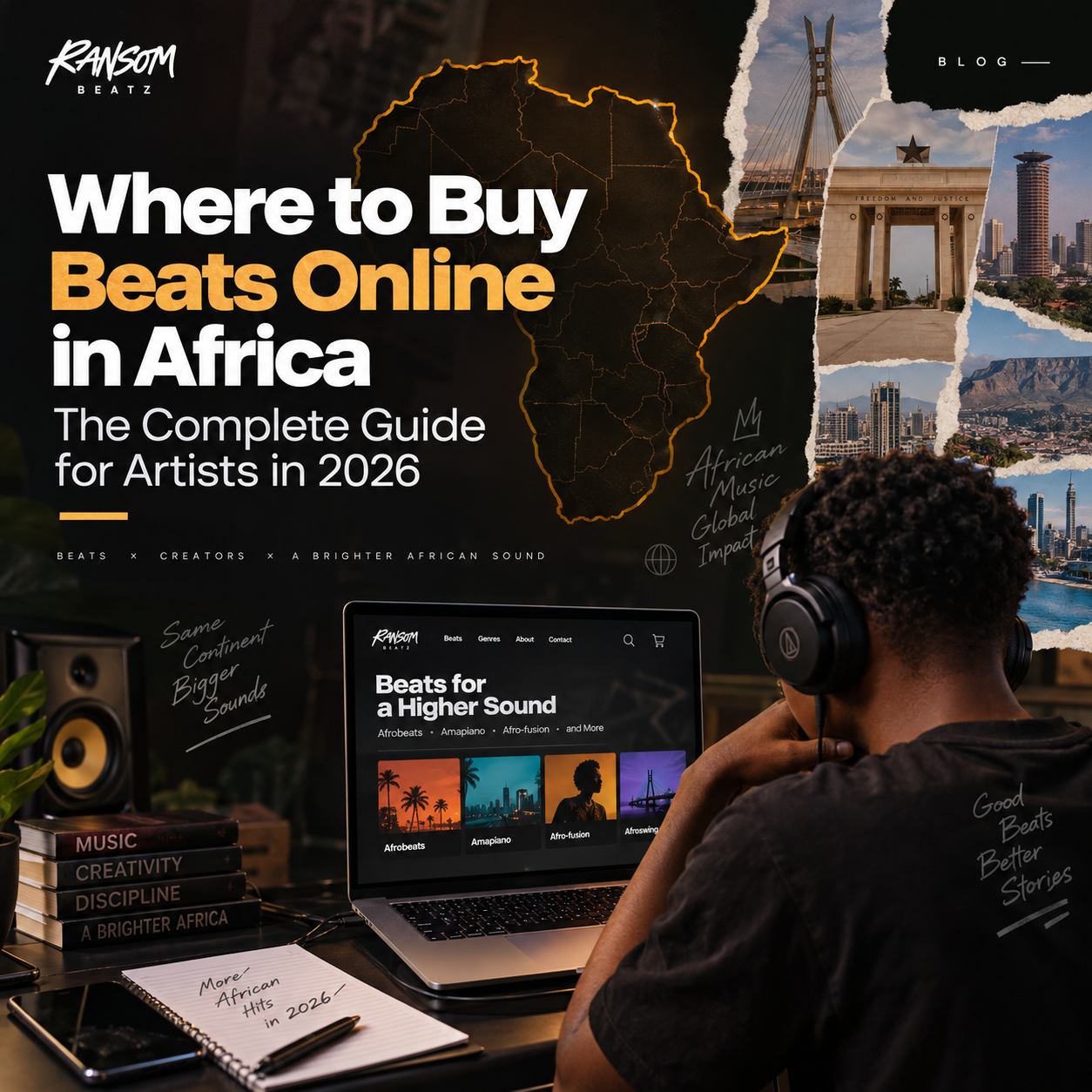
If you're an independent artist in Africa, finding the right beat shouldn't mean spending hours searching YouTube, sending DMs to producers, or wondering whether the beat you're downloading is actually cleared for commercial use.
In 2026, there are more ways than ever to buy beats online in Africa. Artists can discover producers from Nigeria, Ghana, South Africa, Kenya, Uganda, Tanzania, Côte d'Ivoire, Senegal and beyond without ever stepping into a physical studio.
But having more options also creates a new problem:
How do you know where to buy beats, which license you need, and whether you're actually getting the rights you need for your song?
This guide breaks it all down.
Where Can You Buy Beats Online in Africa?
There are several ways African artists can find and purchase beats online.
1. Producer-owned beat stores
Many professional producers operate their own online stores where artists can browse their catalogs, listen to previews and purchase licenses directly.
This can be one of the easiest ways to work with a producer because you're buying directly from the source.
For example, Ransom Beatz offers a large catalog of Afrobeats, Afro-fusion, Afroswing, Amapiano-inspired and other contemporary African-inspired instrumentals through its online store.
Artists can browse the catalog, preview beats and choose the license that fits their project.
Shop Ransom Beatz: shop.ransombeatz.com
A producer-owned store can also be useful when you already know the producer whose sound you want.
2. Beat marketplaces
Beat marketplaces bring producers and artists together in one platform.
Instead of visiting individual producer websites, you can search through catalogs from multiple producers.
Some platforms serving artists and producers include:
- BeatStars
- Airbit
- Traktrain
- Trakroom
The advantage is variety. You can compare different producers, genres, tempos and licensing options in one place.
However, marketplace size isn't everything.
A huge catalog can actually make finding the right beat harder. If you're specifically looking for modern Afrobeats, Afro-fusion, Amapiano, Afroswing or African R&B, the producer's sound and catalog quality matter more than simply having millions of beats available.
Why African Artists Are Buying Beats Online
The way music is created has changed dramatically.
An artist in Lagos can record vocals over a beat produced in Abuja.
An artist in Accra can collaborate remotely with a producer in Nairobi.
A singer in Johannesburg can discover a Nigerian producer through YouTube and release a song to listeners around the world.
Geography is no longer the major barrier it once was.
Beat marketplaces and online producer stores make this possible by allowing artists to:
- Discover producers
- Preview beats before purchasing
- Compare licensing options
- Purchase beats online
- Receive files digitally
- Collaborate remotely
- Release music without meeting the producer physically
This is especially important for independent artists who don't have a record label or large production budget behind them.
What Types of Beats Can You Buy Online?
The African music scene is incredibly diverse, so don't limit your search to just "Afrobeats."
Depending on the producer and marketplace, you can find instrumentals in styles such as:
Afrobeats
Modern Afrobeats instrumentals inspired by the sounds coming from Nigeria, Ghana and the wider African music scene.
Afro-fusion
A combination of African rhythms with R&B, hip-hop, dancehall, pop and other international influences.
Amapiano
South African-influenced production featuring log drums, piano melodies, deep basslines and dance-oriented grooves.
Afroswing
A fusion of Afrobeats, Afro-fusion, UK sounds, hip-hop and melodic songwriting.
Afro R&B
More melodic and atmospheric production designed for singers and R&B artists.
Afrohouse
Dance-focused African production combining house music with African percussion and melodies.
Highlife
Guitar-driven and rhythmically rich production influenced by traditional West African highlife.
African Hip-Hop
Hip-hop production incorporating African drums, melodies, rhythms and modern rap production.
You can also find Trap, R&B, Drill, Gospel, Dancehall, Pop and experimental sounds from African producers.
How Much Does It Cost to Buy a Beat in Africa?
There is no single price for an online beat.
The price depends on the producer, license and rights included.
You might find basic licenses for relatively affordable prices, while more comprehensive licenses and exclusive rights can cost significantly more.
Instead of asking:
"How cheap is this beat?"
Ask:
"What rights am I getting for my money?"
A $20 beat isn't necessarily a better deal than a $100 beat if the cheaper license doesn't give you the rights you need.
Understanding Beat Licenses Before You Buy
This is the part many new artists overlook.
When you buy a beat online, you're usually buying a license to use the beat, not automatically purchasing ownership of the underlying instrumental.
Different producers use different license structures, but common options include:
Basic / MP3 License
Usually the entry-level option.
It may be suitable for demos, smaller releases or artists who are still testing a song.
However, you should always check the specific limitations on streams, sales, distribution and monetization.
WAV / Unlimited License
A higher-level license may provide a professional WAV file and significantly broader commercial usage rights.
This is often more appropriate when you're serious about releasing and promoting the song.
Stems License
Stems give you individual elements of the instrumental, such as:
- Drums
- Bass
- Melodies
- Percussion
- Instruments
- Effects
This can be extremely useful for mixing, mastering and making the beat fit your vocals properly.
Exclusive License
An exclusive agreement generally means the producer stops licensing the beat to new artists after the exclusive sale, subject to the terms of the agreement.
But don't assume "exclusive" means you automatically own every copyright interest in the music.
Always read the actual contract.
What Should You Check Before Buying a Beat?
Before clicking the purchase button, check these things.
1. What exactly is included?
Does the license include:
- MP3?
- WAV?
- Stems?
- Instrumental?
- Trackouts?
- Commercial use?
- Music video rights?
- Streaming rights?
- Distribution rights?
Don't assume. Check.
2. Are there streaming limits?
Some licenses may have limits on the number of streams, sales or downloads.
If you expect your song to become successful, a restrictive license can become a problem later.
Imagine releasing a song that suddenly gets millions of streams and discovering that your original license only allowed a fraction of that usage.
Understand the limits before you release.
3. Can you monetize the song?
If you're planning to upload your song to:
- Spotify
- Apple Music
- YouTube
- Audiomack
- Boomplay
- Amazon Music
- TikTok
make sure your license permits the intended commercial use.
4. Are you allowed to use Content ID?
Content ID and other automated copyright systems can create complications when multiple artists are legally using the same non-exclusive beat.
If you're planning a serious commercial release, understand exactly what the producer's license says about copyright claims and Content ID.
5. Are samples or third-party material involved?
This is particularly important when buying beats online.
Ask whether the instrumental contains:
- Samples
- Loops
- Vocal samples
- Third-party recordings
- AI-generated material
- Other copyrighted elements
A professional producer should be transparent about material that could affect your release.
Should You Buy a Beat or Hire a Producer?
It depends on what you're trying to create.
Buying an existing beat makes sense when:
- You already know the sound you want
- You need production quickly
- You're working with a limited budget
- You want to record immediately
- You find an instrumental that already fits your song
Hiring a producer for custom production makes more sense when:
- You have a very specific sound in mind
- You want the instrumental built around your vocals
- You need something completely original
- You're working on a major single
- You want a long-term producer relationship
Neither option is automatically better.
The important thing is choosing the production process that fits the song.
Why Buying From African Producers Can Make Sense
African artists don't have to look outside the continent for world-class production.
Some of the most recognizable sounds in global music are being developed by African producers.
Buying directly from African producers can also make it easier to find production that naturally understands the rhythms, melodies and songwriting styles associated with African music.
For example, an artist looking for a modern Afrobeats instrumental may get better results by searching specifically for African producers rather than searching through generic "pop beats."
The same applies to Amapiano, Highlife, Afrohouse, Afroswing and other regional sounds.
YouTube Is Great for Finding Beats — But Be Careful
YouTube is one of the biggest discovery platforms for producers.
You can search things like:
"Burna Boy type beat"
"Wizkid type beat"
"Rema type beat"
"Afrobeats type beat 2026"
"Amapiano type beat"
and discover thousands of instrumentals.
But there's an important distinction:
Finding a beat on YouTube is not the same thing as licensing the beat.
A beat may be available to listen to for free while still requiring a commercial license before you can legally distribute your song.
The safest approach is to follow the producer's official purchase link and obtain the actual license and files.
Don't rely on a YouTube description that simply says "free beat" without understanding the usage terms.
How to Choose the Right Beat for Your Song
Don't choose a beat just because it has a lot of views.
The right beat should fit your artist identity.
Before buying, ask yourself:
Does the beat fit my voice?
A great instrumental can still be completely wrong for your vocal range.
Can I write naturally over it?
If you're forcing lyrics onto the beat, that's usually a warning sign.
Does the beat leave space for vocals?
Some instrumentals sound incredible on their own but become overcrowded once vocals are added.
Does the production match my target audience?
Think about where you want the song to live.
Are you making:
- A club record?
- A streaming single?
- A street record?
- A romantic song?
- A TikTok-focused song?
- An international Afrobeats record?
- An album track?
The beat should support the objective.
Where Should Artists in Different African Countries Buy Beats?
You don't have to limit yourself to producers in your own country.
Nigeria
Nigerian artists can buy from Nigerian producers, international marketplaces and producer-owned stores.
Look for Afrobeats, Afro-fusion, Afroswing, R&B, Amapiano and other contemporary styles.
Ghana
Ghanaian artists can explore Afrobeats, Highlife, Afrofusion, Hip-Hop, Drill and other West African sounds.
South Africa
Artists can explore Amapiano, Afrohouse, Gqom, Afropop and other South African-inspired production.
Kenya
Kenyan artists can explore Afropop, Afrobeat, Gengetone-influenced production, R&B, Hip-Hop and other contemporary African styles.
East Africa
Artists across Uganda, Tanzania, Rwanda and neighboring markets can search for producers locally or internationally depending on the sound they need.
Francophone Africa
Artists in Côte d'Ivoire, Senegal, Cameroon and other Francophone markets can also purchase beats internationally and work with producers across the continent.
The internet means your producer doesn't have to live in the same city — or even the same country.
Why Licensing Your Beat Matters
Imagine you spend months writing, recording and promoting a song.
It starts gaining traction.
Then you discover that you never actually obtained permission to commercially use the instrumental.
That's a situation you want to avoid.
A legitimate beat purchase should give you documentation explaining what you've purchased and what you're allowed to do.
Keep:
- Your receipt
- Your license agreement
- Downloaded beat files
- Stems, if included
- Producer information
- Purchase confirmation
Treat your beat license like any other important music-business document.
Buying Beats Online in Africa Is Becoming Easier
The African music industry is becoming increasingly digital.
Artists no longer need to live in Lagos, Accra, Johannesburg or Nairobi to access professional music production.
You can discover a producer online, listen to their catalog, purchase a license and start recording — often within minutes.
The biggest change isn't simply that more beats are available.
It's that artists now have more control over how they create music.
You can choose your producer.
You can choose your sound.
You can choose your license.
And you can build your music career without waiting for someone to introduce you to the "right" producer.
Buy Beats Online From Ransom Beatz
If you're looking for professional Afrobeats and contemporary African-inspired instrumentals, you can browse the Ransom Beatz catalog online.
The store features beats designed for artists looking for modern sounds across Afrobeats, Afro-fusion, Afroswing, R&B and related styles.
You can listen to beats before purchasing and select the license that fits your project.
Whether you're recording your first single or preparing your next major release, start with a beat that gives your vocals room to become the song.
Browse the Ransom Beatz catalog: shop.ransombeatz.com
Frequently Asked Questions
Where can I buy beats online in Africa?
You can buy beats through producer-owned online stores and beat marketplaces such as BeatStars, Airbit, Traktrain and Trakroom. Many individual African producers also operate their own stores.
Can I buy Afrobeats instrumentals online?
Yes. Afrobeats is one of the most widely available styles on online beat stores. You can find production from Nigerian, Ghanaian and other African producers.
Can I buy beats from a producer in another African country?
Yes. Online beat stores allow artists to purchase and license instrumentals from producers regardless of where they are located.
Can I use a purchased beat on Spotify?
That depends on your license. Before releasing your song, check that the specific license allows commercial distribution and streaming on platforms such as Spotify and Apple Music.
Do I own the beat after buying it?
Usually, no. Most online beat purchases are licenses that grant you specific rights to use the instrumental. Ownership and copyright terms depend on the agreement.
Is a free beat on YouTube free to use commercially?
Not necessarily. "Free for non-profit" or similar language usually does not mean you can commercially release and monetize the resulting song. Always check the producer's terms.
Should I buy MP3, WAV or stems?
Choose based on your needs. MP3 can work for basic uses, while WAV is generally more appropriate for professional recording and mixing. Stems are useful when you need greater control over the instrumental during mixing.
Can African artists buy beats using local payment methods?
Payment options vary by producer and platform. Some African-focused stores and marketplaces are increasingly supporting payment methods and currencies relevant to African buyers, while international platforms may have different payment availability depending on the buyer's country.
Final Thoughts
The best beat isn't necessarily the most expensive beat, the beat with the most views or the beat from the biggest producer.
It's the beat that gives your song the best foundation.
Take your time, listen carefully, understand the license, make sure the beat fits your voice and confirm that the rights match how you plan to release the music.
And when you find the one?
Buy the license, download the files, get in the studio and make the record.
Ready to find your next beat?
Shop Ransom Beatz → shop.ransombeatz.com